 Social Hungama Hindi News, हिंदी न्यूज़ , Hindi Samachar, हिंदी समाचार, Latest News in Hindi, Sarkari Result
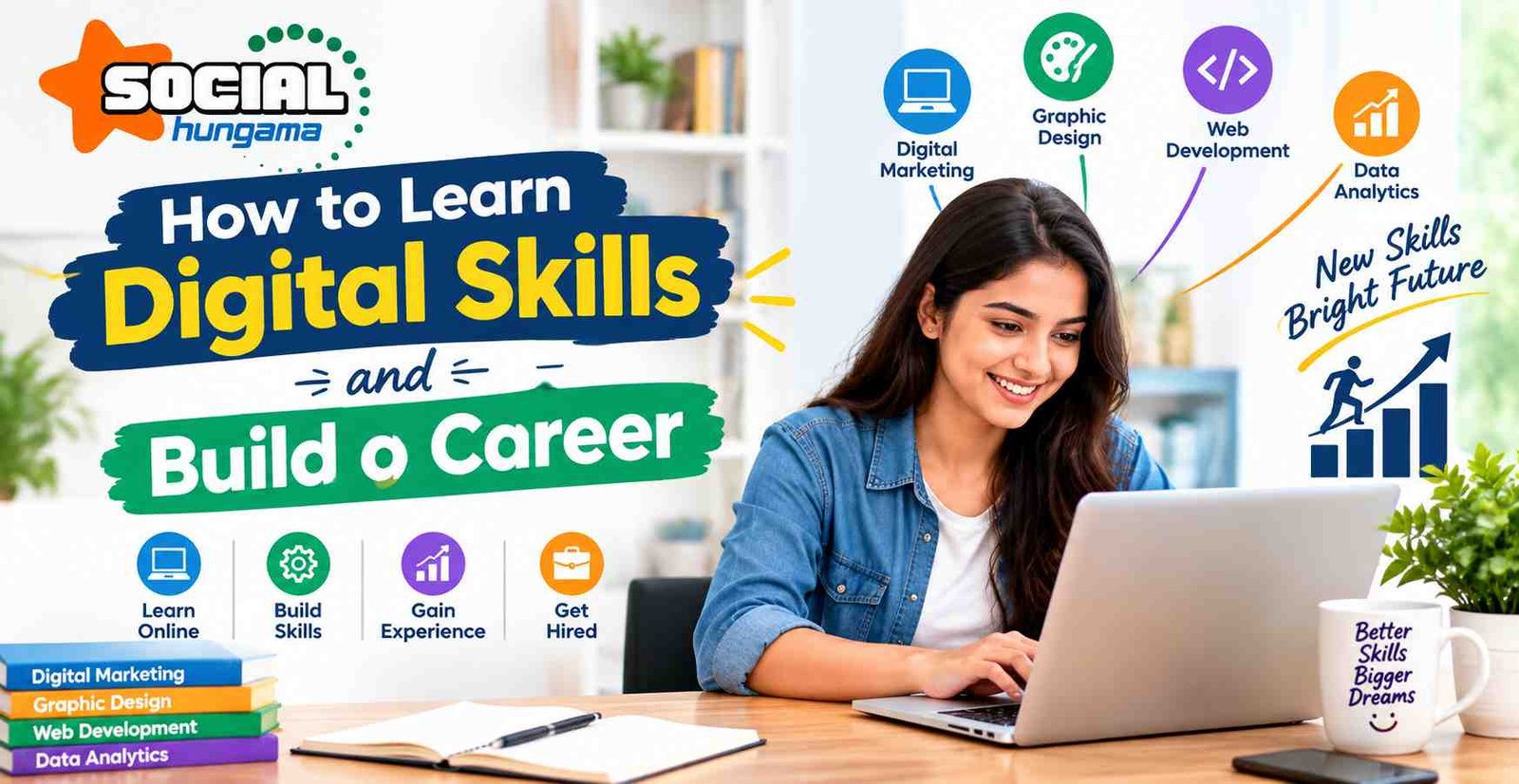
How to Learn Digital Skills and Build a Career
How to Learn Digital Skills and Build a Career: You don’t need to be a technology expert to build a successful digital career. If you are a student, job seeker, working professional, or someone planning a career change, learning the right digital skills can help you create new opportunities.
The biggest challenge for beginners is not finding information—it is knowing what to learn, where to start, how to practice, and how to turn a skill into a career.
From digital marketing and SEO to web development, graphic design, content writing, data analysis, and AI tools, there are many digital skills for beginners to explore. But you don’t need to learn everything. A better approach is to choose one skill, understand its fundamentals, practice regularly, build real projects, and gradually develop professional experience.
This guide explains how to learn digital skills and build a career step by step, even if you are starting from zero.
What Are Digital Skills?
Digital skills are the abilities needed to use technology, digital platforms, software, and online tools effectively.
Some digital skills are basic, such as using email, search engines, online documents, video-conferencing platforms, and cloud storage. Other skills are more specialized, including:
- Digital marketing
- Search engine optimization (SEO)
- Content writing
- Graphic design
- Video editing
- Web development
- Data analysis
- Artificial intelligence
- Social media management
- Cybersecurity
The right skill for you depends on your interests, existing knowledge, career goals, and the type of work you want to pursue.
Why Should You Learn Digital Skills?
Technology is now part of everyday business operations. Companies use websites, digital marketing, online communication, data, cloud services, and software to operate and reach customers.
Developing digital skills can help you:
- Improve your professional abilities
- Prepare for digital jobs
- Explore freelancing
- Develop work-from-home skills
- Start online projects
- Improve workplace productivity
- Build a professional portfolio
- Explore a new career direction
However, learning a skill is only the first step. Practical experience is what helps turn knowledge into something you can demonstrate to employers or clients.
Best Digital Skills to Learn for Beginners
There is no single digital skill that is perfect for everyone. Choose according to your interests and career goals.
1. Digital Marketing
Digital marketing involves promoting products, services, or businesses through online channels. It can include SEO, social media marketing, email marketing, content marketing, and analytics.
2. SEO
SEO helps websites improve their visibility in search engines. Beginners can start with keyword research, on-page SEO, content optimization, technical basics, and search intent.
3. Content Writing
If you enjoy writing and research, content writing can be a useful skill to develop. Blog posts, website content, product descriptions, and informational articles are common examples.
4. Graphic Design
Graphic design involves creating visual content for websites, social media, marketing campaigns, presentations, and businesses.
5. Web Development
Web development is suitable for people interested in technology and coding. Beginners can start with HTML and CSS before progressing to JavaScript and other technologies.
6. Data Analysis
Data analysis involves working with information to identify patterns and support decision-making. Beginners can start with spreadsheets and gradually learn databases, visualization, and programming tools.
7. AI Tools
AI tools are increasingly used for research, productivity, writing assistance, brainstorming, coding, data-related tasks, and automation. Learning how to use AI effectively can complement other digital skills.
How to Learn Digital Skills and Build a Career Step by Step
Step 1: Choose One Skill
Don’t try to learn five or ten skills simultaneously.
First, choose one skill that matches your interests and career objective. For example, someone who enjoys writing may start with content writing and SEO, while someone interested in technology may explore web development.
One skill + consistent practice is better than many unfinished courses.
Step 2: Learn the Fundamentals
Start with basic concepts before moving to advanced topics.
Use reliable learning resources, tutorials, documentation, books, and structured courses. Focus on understanding how and why something works instead of simply memorizing steps.
Step 3: Practice Every Day
Knowledge becomes useful when you can apply it.
Spend time creating small exercises and projects. If you’re learning SEO, optimize a sample article. If you’re learning web development, build a simple webpage. you’re learning graphic design, create sample social media designs.
Your projects don’t need to be perfect. They need to show improvement.
Step 4: Build Real Projects
Projects are one of the best ways to demonstrate digital skills.
Start with simple projects and gradually increase their difficulty.
For example:
- Create a basic project.
- Identify its weaknesses.
- Improve the project.
- Create a second project.
- Compare your progress.
- Document what you learned.
This process develops both technical knowledge and problem-solving ability.
Step 5: Create a Digital Portfolio
A portfolio gives employers and potential clients evidence of your work.
Depending on your skill, your portfolio could include:
- Websites
- Blog articles
- SEO projects
- Graphic designs
- Videos
- Marketing campaigns
- Data dashboards
- Case studies
- Personal projects
You don’t need hundreds of examples. Start with a few strong projects and keep improving them.
Step 6: Improve Communication Skills
Digital careers are not only about technical knowledge.
You should also learn how to communicate professionally, explain your ideas, write clear messages, understand requirements, present your work, and work with other people.
Strong communication can make it easier to collaborate with employers, clients, and teams.
Step 7: Gain Practical Experience
Once you have basic knowledge and a portfolio, look for ways to gain real experience.
You can explore:
- Internships
- Freelance projects
- Entry-level jobs
- Personal projects
- Small-business projects
- Volunteer opportunities
- Professional communities
Real-world projects teach you things that tutorials cannot fully replicate, such as deadlines, client requirements, revisions, teamwork, and problem-solving.
How to Build a Digital Career Without Experience
Being a beginner does not mean you have nothing to show.
Start by creating self-initiated projects. For example, create a sample website, write a series of SEO articles, design a fictional brand campaign, analyze publicly available data, or build a small coding project.
Document your process and results.
Then create a resume and portfolio that clearly explain:
- What skill you learned
- What project you created
- Which tools you used
- What problem you solved
- What you learned from the project
This gives your learning a practical context.
Learn AI Alongside Your Main Skill
AI is becoming an important part of many digital workflows. Instead of treating AI as a separate replacement for every skill, beginners can learn how to use it alongside their primary area.
For example:
- Writers can use AI for brainstorming and research assistance.
- Marketers can use AI for ideas and workflow support.
- Developers can use AI coding assistants.
- Designers can explore AI-assisted creative tools.
- Professionals can use AI for productivity and repetitive tasks.
Always review and verify important outputs rather than accepting AI-generated information without checking it.
Simple 90-Day Digital Skills Action Plan
If you don’t know where to begin, use this simple framework.
Days 1–30: Learn
Choose one skill and study its fundamentals. Practice the basics regularly.
Days 31–60: Build
Create two or three practical projects. Apply what you have learned instead of only watching tutorials.
Days 61–90: Showcase
Create a portfolio, improve your resume, document your projects, and begin looking for internships, freelance opportunities, or entry-level positions.
After 90 days, continue improving rather than starting over with another unrelated skill.
Common Mistakes Beginners Should Avoid
Learning Too Many Skills
Jumping from one skill to another can slow your progress. Build a foundation in one area first.
Only Watching Tutorials
Watching videos feels productive, but real learning happens when you apply the concepts.
Collecting Certificates Without Projects
Certificates can document learning, but practical projects demonstrate what you can actually do.
Waiting to Become Perfect
You will improve by creating, making mistakes, receiving feedback, and trying again.
Ignoring Communication
Technical ability and communication should develop together.
How Long Does It Take to Learn a Digital Skill?
There is no fixed timeline. It depends on the skill, your previous experience, the amount of time you can dedicate, and how consistently you practice.
A beginner can focus on learning fundamentals first and then gradually move toward practical projects. Instead of asking, “How quickly can I become an expert?” ask:
“What can I learn and build this week that I couldn’t do last week?”
That mindset makes long-term progress easier.
Final Thoughts
Learning digital skills and building a career is a long-term process. You don’t need to master every technology or follow every new trend.
Choose one relevant skill, learn the fundamentals, practice consistently, build real projects, create a portfolio, improve your communication, and gradually gain professional experience.
The most important cycle is simple:
Learn → Practice → Build → Showcase → Improve → Repeat.
If you stay consistent and keep adapting as technology changes, your digital skills can become a valuable foundation for employment, freelancing, remote work, entrepreneurship, and long-term career development.
Frequently Asked Questions
Which digital skill should a beginner learn first?
Choose a skill that matches your interests and career goals. Digital marketing, SEO, content writing, graphic design, web development, data analysis, and AI-related skills are some areas beginners can explore.
Can I learn digital skills without a technical background?
Yes. Many digital skills have beginner-level learning paths. Start with the fundamentals and progress gradually through practice.
Can digital skills help with freelancing?
Yes. Skills such as content writing, SEO, graphic design, web development, video editing, and digital marketing can be used for freelance services, depending on your ability and market demand.
Is learning AI enough to build a career?
AI can complement many careers, but building a sustainable career generally requires a broader skill set. Combining AI tools with a specific professional skill can make your learning more practical.
What is the best way to learn digital skills?
A practical approach is to combine structured learning with regular practice and real projects. Build a portfolio as you progress instead of waiting until you finish learning everything.




2 comments
Pingback: How to Lose Weight Naturally: Healthy Tips for Beginners - Social Hungama
Pingback: Elina Devia Biography: Age, Height, Career, Family & More - Social Hungama